AI game assets: copyright, player trust, and pipeline discipline
A FIELD GUIDE TO AI ASSETS, THE LAW, AND WHY PLAYERS BOUNCE
The law cares where your assets came from, and so do your players. This guide came out of a long conversation in the AI Game Dev Org Discord about AI assets, copyright, and what players actually notice. Written by RedPando, with the jurisdiction breakdown from 0xe25f, the distribution point from ktyl, the rights-clear packs from theChief, and kat keeping the wider debate honest. Corrections and additions are welcome in the community; good ones get folded in so this page stays current.
Part one: the law, straight
If you are shipping on Steam or any major storefront, you are subject to US law in practice, wherever you live. Plan for the strictest market you will sell into and most of the jurisdiction debate stops mattering. If that is you, skip to part two.
For everyone else, the differences are real.
United States
Raw generations are not protected. You need extensive human edits, and even then only the edits are protected unless the result is no longer recognisable as the generation. If copyright concerns you and you are selling into the US, editing heavily or making the sprite yourself is the safe route.
United Kingdom
The Copyright, Designs and Patents Act protects computer-generated works. Whoever made the arrangements necessary for the work’s creation counts as the author, so even raw AI sprites can carry protection. Two catches: the term is 50 years rather than life plus 70, and no moral rights attach. The provision is thin on case law and has been under government review, so treat it as strong on paper and lightly tested in court.
European Union
Protection requires an intellectual creation reflecting the creator’s personality, which you would need to be able to demonstrate. Substantial editing is one recognised way. It remains a grey area.
Before you lose sleep over any of this: copyright only bites if someone rips your art and you want to stop them. For most indie devs it is the least of your worries. What decides whether your game gets played comes next.
Part two: the care detector
Players run care detectors. AI just made carelessness faster to produce.
People bounce off a game when it signals that nobody thought about any of it, whatever tool made the assets. A default engine skybox, a title card in a system font, an asset pack dumped in exactly as it came out of the box, a set of raw AI generations that don’t sit together. All of it trips the same wire. The detector fires on carelessness.
Incoherence is the biggest tell. Diffusion output isn’t coherent across generations no matter how carefully you prompt, so a game assembled from one-off generations reads as visually random to a sharp eye, where a hand-picked asset pack reads as coherent almost by accident. Players read that inconsistency as carelessness, and carelessness as a reason not to invest another minute.
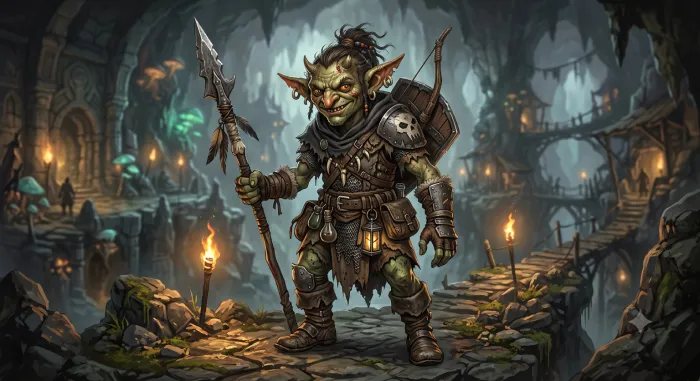
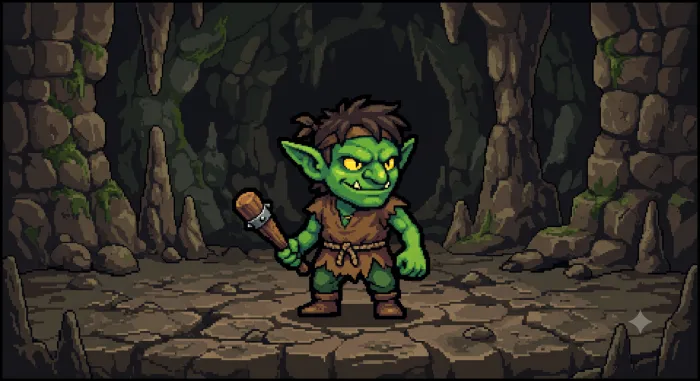
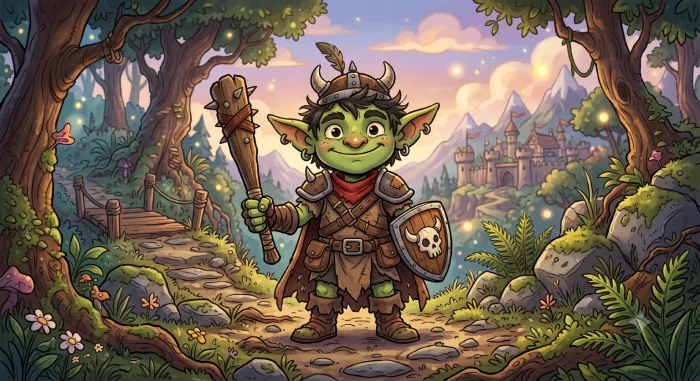
The commercial risk is silent. Players who clock lazy asset use rarely complain, they just leave, and you never find out why. Honest feedback before launch is the only detector you get to run on yourself, which is half the reason our community exists.
Hating on AI has a shelf life, same as it did for the camera, because what people hate is the absence of effort. A photo snapped without thought is a snapshot. The same camera pointed with intention is photography.
Part three: pipeline discipline
Coherence on purpose. It costs attention, and the budget is optional.
If you can afford to commission an artist, that is a great option and it stacks cleanly with everything here. Nothing below costs money. It costs deciding on a pipeline and holding to it.
Lock one model
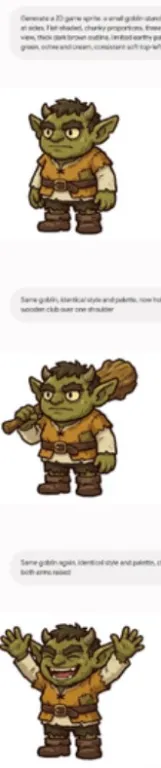
Pick a model and generation settings and use them for every asset in the project. Style drift between models is the loudest incoherence there is.
Iterate, never ship the first output
Generate multiples, choose deliberately, regenerate what doesn’t fit. Taking the first result is the AI equivalent of shipping placeholder art.
One post-process pass over everything
Run every asset through the same finishing pass: same downscale, same sharpening, same grain or outline treatment. A shared pass glues mismatched generations together.
A worked version for pixel art: nearest-neighbour downscale to a fixed sprite size, index to one palette, 1px dark outline, applied to everything with no exceptions. Which specifics you pick matters less than picking them once.
Force a palette
Impose one palette across all assets after generation. Colour is the cheapest and strongest coherence lever available.
Concept with AI, finish by hand
Use generation to explore fast, then redraw or heavily rework the keepers. This also puts you on the safe side of every jurisdiction in part one.
Tools for the pass, all free
- Photopea: Photoshop in a browser tab, no install, no account
- LibreSprite: sprite editor, handles palette indexing properly
- ImageMagick: command line, runs the identical pass over a whole folder in one go
- Lospec: palette library, pick one and commit to it
- GIMP: if you need the full toolbox
Aseprite is the standard for pixel work and is paid. Worth it if you are going to be in it daily.
Part four: rights-clear sources and honest credits
CC0 means the source marks an asset for broad reuse. CC-BY means credit is required. “Varies” means the specific asset or listing must be checked before use.
| Source | What | Licence | Checked |
|---|---|---|---|
| Kenney | 2D and 3D packs, UI, audio | CC0 | Aug 2026 |
| Quaternius | Low-poly 3D packs | CC0 | Aug 2026 |
| Poly Haven | HDRIs, textures, models | CC0 | Aug 2026 |
| ambientCG | PBR materials | CC0 | Aug 2026 |
| OpenGameArt | Mixed assets, check each asset | Varies | Aug 2026 |
| Freesound | Sound effects, check each asset | Varies | Aug 2026 |
This is a starting set; more sources are added as the community verifies them. This is not legal advice: check the current licence text and keep a record for each asset you use.
Two community rules apply everywhere and exist for exactly this topic. Credit your sources: if you ship AI assets, models, packs, or someone’s code, say where it came from. Be honest about what is AI and what is hand-made. Nobody here cares which tools you used. People care about being misled.
Made something with this pipeline? Post it in the community’s feedback forum with a specific question; the games that go through that process are what end up on the showcase.